Tuesday, May 14, 2013

Study questions if bed rest prevents prematurity


WASHINGTON (AP) — New research is raising fresh concern that an age-old treatment for troubled pregnancies — bed rest — doesn't seem to prevent premature birth, and might even worsen that risk.
Doctors have known for years that there's no good evidence that bed rest offers any benefit for certain pregnancy complications, and it can cause side effects in the mother, not to mention emotional and financial strain. Yet estimates suggest nearly 1 in 5 moms-to-be is told to cut her activity — ranging from quitting work to actually staying in bed all day — at some point during pregnancy.
Now, spurred by the latest study, some specialists are issuing a call for strict studies to finally settle the controversy — and until then, for doctors not to assume that a prescription to take it easy can't hurt.
"Bed rest is misperceived as an inexpensive, innocuous, logical recommendation," Dr. Joseph Biggio Jr. of the University of Alabama at Birmingham wrote in the latest issue of Obstetrics & Gynecology, a journal read by thousands of OB-GYNs.
In a separate review of past studies that failed to support bed rest, a trio of obstetricians and ethicists at the University of North Carolina, Chapel Hill, went a step farther: They said it's not ethical to keep prescribing bed rest unless the women are enrolled in a research study, like they are for other unproven treatments.
So why is rest prescribed so often? There aren't a lot of good treatments to prevent prematurity and other problems.
"Patients want you to do something, and physicians want to do something," explained Dr. Catherine Spong, a maternal-fetal medicine specialist at the National Institutes of Health who co-authored the latest research.
Spong and colleagues took a closer look at a study of treatments for women at risk of premature birth because of an increasingly diagnosed complication called a short cervix. Bed rest is a broad term that doesn't just mean staying in bed all the time — and during that treatment study, doctors were free to decide if the participants also should restrict their activities, essentially offering a real-world test of the effects. The prescriptions ranged from no sexual activity, to partial or complete work restrictions, to complete restriction of non-work activity as well.
Nearly 40 percent of the 646 pregnant women enrolled in the study were prescribed some type of activity restriction in the second or third trimester. Most were told to restrict all three types of activity — sexual, work and non-work — what's usually considered bed rest.
The surprise: Some 37 percent of women who took the precautions had a premature baby, compared with just 17 percent of the women who didn't scale back, the researchers report in Obstetrics & Gynecology.
"The data suggests that bed rest does not prevent preterm birth in this high-risk population, but it doesn't definitively answer that question," cautioned Spong. She wants to see a more strict study — the kind that randomly assigns women to rest or not — to prove if there's a difference.
The study also raises questions about harm, although the women who rested merely may have been at higher risk for a preemie. They were older and had somewhat more serious cervical complications. But the researchers pointed to other studies that link bed rest to increased stress and anxiety, both of which are associated with prematurity and smaller babies.
Plus, bed rest is well known to increase a mother's risk of a dangerous blood clot, as well as side effects including bone and muscle loss.
Interestingly, the new study found those who rested were more likely to have private insurance, raising questions about the influence of social rather than medical factors.
The American College of Obstetricians and Gynecologists says bed rest shouldn't be "routinely recommended" for prevention of preterm birth. And women face a tough decision when their doctors do bring it up.
Sandy Lutton spent the last 18 weeks of her pregnancy lying flat in bed, forbidden even to prop up with her laptop, hoping it would prevent her twins from being born too soon.
"I'm not going to sugarcoat it, it was stressful," said the McLean, Va., woman, whose twins, now 2, were born healthy. "I had a lot of time to sit and worry."
Her first son had been born on time, but she'd lost a second baby due to a weak cervix. With the twins, her doctors stitched her cervix closed and recommended strict bed rest, while making it clear there was no proof it would make a difference. Lutton bombarded them with questions, but eventually decided she had to try. Ultrasound exams showed her cervix stayed fine until doctors removed the stitch and delivered her babies; she even cheated with a little extra movement on exam days.
Amid the uncertainty, March of Dimes medical adviser Dr. Siobhan Dolan said women shouldn't hesitate to ask their doctors about the pros and cons of restricting activity.
"Sometimes you feel less regret if you did something even though it didn't change the outcome," acknowledged Dolan, who herself has prescribed bed rest less often in recent years.
News Source: http://news.yahoo.com

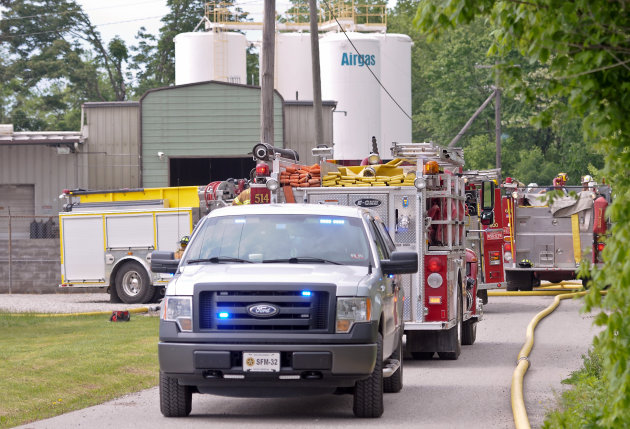
2 hurt in explosions, fire at W.Va. gas plant

POCA, W.Va. (AP) -- Two workers were injured Monday when highly flammable gas used in welding exploded at a West Virginia industrial site, officials said.
Fire crews were sent at about 3:20 p.m. to Airgas, a distributor of specialty gases in Poca, outside of Charleston. Putnam County emergency management director Frank Chapman said the explosion involved about 50 tanks of acetylene that were at Airgas waiting to be refilled. What caused the tanks to explode wasn't known.
Chad Jones, a firefighter with the Bancroft Volunteer Fire Department, said four cylinders continued to burn Monday evening and that crews were letting them "burn out." They were dousing other tanks with water to keep them from exploding, said Jones, whose station was one of several to respond to the scene.
The tanks were being stored in a bay behind the facility. Jones said after the first tank exploded, "it was like a chain reaction," with fireballs shooting 100 to 150 feet in the air. A nearby business was evacuated, and windows were shattered in the back of the Airgas plant, Jones said.
Doug Barker, chief financial officer at nearby Clark Truck Parts, told The Associated Press over the phone that "we felt our building shake like it's never come close to shaking before from a storm or anything. It was enough to make us run."
Barker said he and another company official bolted from their offices, and he ran to the road and saw dark smoke in the air. Soon afterward, they heard several smaller explosions and saw fire, he said. Barker also saw three or four ambulances speed by and heard a lot of sirens.
Clark Truck Parts is about half-mile from Airgas, Barker said. He said there are some homes between the two industrial sites.
Dave Castro, manager of the TransWood trucking company about a quarter-mile from Airgas, said he also felt his building shake.
"It felt like a truck ran into the building," he said.
He said he drove toward Airgas to check on his wife, who works at another company nearby, and could see the back of the plant on fire. He said the burning area was about the size of a house, and every 15 seconds or so a black ball of smoke would rise from a tank or drum "and explode like a firework."
Acetylene is used in welding canisters. Airgas calls itself the largest U.S. supplier of industrial, medical and special gases. The company also lists on its website propane, often used in backyard grills; hydrogen, helium; and nitrous oxide, or the "laughing gas" used during some dental procedures.
Company spokesman Doug Sherman said the explosions occurred in a concrete-enclosed storage area located outside of the main plant. He said the injuries were not life-threatening, and the fire had been extinguished.
Jones said the company was sending a hazmat crew from Kentucky.
"It's a hazardous job they do every day," Jones said. "Something went wrong today."
A U.S. Occupational Safety and Health Administration crew was at the scene.
Chapman said the explosion involved residue of the gas left in the tanks. He said the blast would have been much worse if the tanks were filled. He said both workers suffered second and third-degree burns.
Chapman said the cause of the explosion was being investigated and that the blasts and fire were the first problem he knows to be reported at Airgas.
The injured workers were taken to Cabell Huntington Hospital for treatment. A hospital official did not know their conditions.
Airgas Inc. is based in Radnor, Pa., and has more than 15,000 employees at 1,110 locations including retail stores, gas fill plants and distribution centers, according to Hoover's database on companies. It is the largest distributor of packaged gases in the US, with a 25 percent market share and with sales of nearly $5 billion in fiscal 2012.
News So0ruce: http://news.yahoo.com

Right man for the job?: Senator Ishaq Dar tipped to be next finance minister

ISLAMABAD: In all probability, veteran politician Senator Ishaq Dar is likely to become the country’s next finance minister. He will be burdened with the task of fixing the teetering economy, amid hopes that he will refrain from hurting business sentiments through politically-motivated statements.
If appointed, Senator Dar, a two-time former finance minister, faces immediate challenges. He has to present next year’s budget in the shortest possible timeframe, while finding a solution to the looming threat of a national default on international payments due to external debt amortisation.
The options in front of him dictate that either he go straight to the negotiating table for a bailout package from the International Monetary Fund (IMF), or bet on timely help from friendly countries. However, analysts say that relying on friendly countries may not be immediately possible.
Senator Dar was appointed Leader of the Opposition in the Senate of Pakistan on March 14, 2012. He has also served as finance and commerce minister in the past. His first tenure as finance minister was under Nawaz Sharif, and he was appointed to the office again for a short stint under former prime minister Syed Yousaf Raza Gilani in 2008.
Dar achieved his certification in chartered accountancy from the Institute of Chartered Accountants in England and Wales, and was one of the youngest Pakistanis at the time to have passed the professional qualification in the minimum time period. Senator Dar is now a Fellow Chartered Accountant.
In 2008, when Dar was appointed finance minister under Gilani, he presented an extremely bleak picture of the economy which, according to many, had shattered investor sentiment when it was in dire need of diligent rebuilding. Senator Dar had stated in 2008 that the budget deficit would become bigger than 9% of the Gross Domestic Product that year. The announcement shattered the confidence of the business community and foreign investors, who had been hoping to invest in Pakistan in hopes of some stability following a decade of dictatorship. This caused the rupee to plummet and there was a run on the banks.
Former finance ministry officials, however, claim the establishment had actively misled Senator Dar. They say bureaucrats had deliberately painted a sorry picture by taking into account the coming year’s liabilities by applying the accrued accounting model, but took revenues only for that year by applying the cash-based accounting method.
Analysts say Senator Dar must countercheck the facts presented to him by bureaucrats this time around before making them public. There are chances that the bureaucrats may repeat the same episode in a bid to remain in the good books of the government by throwing responsibility on the previous government.
Another allegation against Senator Dar is that he stopped the issuance of Global Depository Receipts (GDRs) of some entities as finance minister in 2008. These had been planned to raise $4 billion from international markets. They included the GDRs of National Bank of Pakistan, Kot Addu Power Company, the sale of 15% shares of Habib Bank and 10% exchangeable bonds of the Oil and Gas Development Company.
The stoppage had led to panic in the market and forced the government to discuss a bailout package with the IMF later on.
However, according to former finance ministry officials, President Zardari had been calling the shots behind the scenes, and had stopped Dar from moving forward on the issue. Former adviser to the finance ministry Dr Ashfaque Hasan Khan, who was serving in the finance ministry at that time, said Senator Dar had been all for the transaction.
Ahsan Iqbal, who was the deputy chairman of the Planning Commission in the 1997 setup, is also tipped to be handed the same post with the status of a federal minister. The Gilani government had abolished the Ministry of Planning and Development, and Nawaz Sharif may revive this ministry.
Following the elections, Standard & Poor’s Ratings Services termed them a key achievement for Pakistan’s maturing democracy in the face of general economic malaise, widespread and incessant sectarian and political violence, large-scale domestic insurgencies, and on-going tension with neighbouring India. S&P said the election outcome puts the incoming government in good stead to seal a deal with the IMF soon.
News Source: http://tribune.com.pk

Raising finance: Govt firms up financing plan for Diamer Bhasha Dam

ISLAMABAD: The Pakistan government has prepared a $12.5 billion funding programme for Diamer Bhasha Dam with resources coming from internal and external sources including the Asian Development Bank, the United States and Islamic Development Bank, seemingly dealing a blow to India’s attempts to block foreign financing for what it calls a controversial project.
According to reports, the Indian lobby in Washington has been actively campaigning against Diamer Bhasha Dam, asking the US and other lenders to link their assistance for the project with a no-objection certificate from New Delhi, which claims that the dam is located in the disputed territory of Gilgit-Baltistan.
Unfurling the financing plan, sources told The Express Tribune that the government had finalised an arrangement with the ADB that will result in a loan of $4 billion for Diamer Bhasha Dam. The ADB has also given the assurance that it will provide more if the need arises.
The other major donor will be the US Agency for International Development (USAID) that has pledged $2 billion over eight years – $250 million per year. “This financing is part of US strategy to cooperate with Pakistan to overcome the energy crisis,” an official of the Ministry of Water and Power said.
Japan and EU countries have also consented to giving $1.5 billion for the dam under the supplier credit programme. In the programme, they will provide equipment and machinery for constructing the dam against financing of $1.5 billion. Repayment of these loans would start after 10 years, the ministry official said.
Islamic Development Bank (IDB) and other Middle Eastern lenders will lend $1.5 billion.
Besides tapping these foreign sources of financing, the Pakistan government will generate $1.5 billion by securitising assets of existing dams like Tarbela, Mangla and Ghazi Barotha.
The United States and other lenders have backed this financing plan, underlining the need for securitising assets of different dams in an effort to secure funds from the international community.
The government is also banking on the recovery of huge unpaid bills by the Water and Power Development Authority (Wapda) from power consumers as the collected amount will go for building the dam. In this programme, Wapda is expected to generate $1 billion.
The central government will also release $1 billion from the Public Sector Development Programme (PSDP) to implement the project.
“The government has already provided Rs15 billion from the PSDP and 12 contracts of different nature have been awarded for completing the dam,” the water and power ministry official said, adding more money would also be provided.
German firm Lemhyer put the cost of the dam at $8.5 billion in 2008 compared to estimates of $6.5 billion in 2005. The cost has gone further up and estimates suggest that it now stands at $14 billion following years of delay as according to the plan construction should have started in 2009.
News Soruce: http://tribune.com.pk

Kerry hoping to visit Pakistan soon


WASHINGTON: 
US Secretary of State John Kerry is hoping to visit Pakistan soon, once the new government of Pakistan Muslim League-Nawaz (PML-N) is in place, a US official said Monday.

The two men already spoke on the phone on Sunday, when the top US diplomat called Sharif “to congratulate him on his strong showing in Saturday’s elections,” State Department spokesperson Jen Psaki told reporters.
Kerry also told Sharif “that he looks forward to working with the government as the government is formed in Pakistan.”
Ties between the two countries soured after the killing of Osama bin Laden in 2011 by US Navy SEALS when he was tracked down to his compound in the Pakistani town of Abbottabad, after a decade on the run.
The killing of 24 Pakistani soldiers in a US-led NATO air strike in November 2011 then led Islamabad to cut off land routes into Afghanistan used by US troops for re-supplying their forces.
Ties were gradually mended, but tensions remained and one thorn in the relationship is US drone strikes targeting Taliban and al-Qaeda militants in the northwestern tribal belt.
Sharif has already promised Pakistan’s “full support” as the United States withdraws combat troops from Afghanistan, but said he would raise the issue of drone strikes with US leaders.
Washington would be hoping to enhance its cooperation with Islamabad on issues such as counter-terrorism, once the government is formed, Psaki said.
Sharif has “indicated he wants to work closely with the US. We would like to have a positive, productive relationship as well on a number of these issues,” Psaki said, adding that first the new government needed to be formed.
News Soruce: http://tribune.com.pk

US, Britain say common ground with Russia on Syria


WASHINGTON DC: 
The United States and Britain on Monday pledged to forge ahead with diplomatic efforts to end the civil war in Syria, saying they had found common ground with Russia on how to proceed.

US President Barack Obama and British Prime Minister David Cameron vowed to increase pressure on the regime of Syria’s President Bashar al-Assad, and insisted that he could not be part of a democratic transition.
“Syria’s history is being written in the blood of her people, and it is happening on our watch,” Cameron told a joint press conference with Obama after they held about 90 minutes of talks in the White House’s Oval Office.
“The world urgently needs to come together to bring the killing to an end. None of us have any interest in seeing more lives lost, in seeing chemical weapons used.”
Cameron, fresh from a trip to Russia, one of Assad’s few remaining backers, said he believed Washington, London and Moscow had found “common ground” on the crisis, which has left tens of thousands dead.
Obama agreed, saying Russia had an “interest as well as an obligation” to work on resolving the crisis.
“If in fact we can broker a peaceful political transition that leads not only to Assad’s departure but a state in Syria that is still intact and that ends the bloodshed, stabilizes the situation, that’s not just going to be good for us — that will be good for everybody,” the US leader said.
Ahead of the talks, Cameron told National Public Radio that US Secretary of State John Kerry made a “real breakthrough” in talks with Russian President Vladimir Putin “when they agreed to an American-Russia peace conference.”
The British leader also said that Putin was “keen now to move from the generalities of having a peace conference to talking through the specifics of how we can make (this) work.”
Obama has resisted directly arming the Syrian opposition but — with reports that Syria has used chemical weapons, which would cross a US a “red line” — is coming under increasing pressure at home and abroad to do so.
Obama said last week that Washington had a moral and national security obligation to stop the slaughter in Syria, but said he wanted more concrete evidence that chemical weapons had been used.
On Monday, he said: “We will continue work to establish facts around the use of chemical weapons in Syria, and those facts will help guide our next steps.”
Cameron and Obama met amid indications that Assad’s regime may not be hustled swiftly out of power, as his army gained ground in the strategic central province of Homs.
The Syrian Observatory for Human Rights watchdog reported that the military, backed by the Lebanese Shiite group Hezbollah, seized much of the strategically vital Qusayr area, which connects the capital Damascus to the coast.
In southern Daraa, which nurtured the Syrian uprising against Assad, the army secured control of the town of Khirbet Ghazaleh, on the route between Damascus and the Jordanian border.
The Observatory said Monday that it has now documented the deaths of some 82,257 people since the beginning of the conflict in March 2011, including 34,473 civilians.
Reverberations meanwhile mounted from a string of deadly bombings in the Turkish town of Reyhanli, which the Ankara government blamed on Damascus.
Thousands of Turks took to the streets to urge their government to rethink its support for rebels fighting Assad, warning that the decision had provoked reprisals against Turkey, including the bombings, which killed 48 people.
Turkish Prime Minister Recep Tayyip Erdogan is due to meet Obama at the White House on Thursday, with Syria also topping their agenda.
In another sign of accelerating diplomacy, the Kremlin said Israeli Prime Minister Benjamin Netanyahu will hold talks on Tuesday with Putin amid concerns Moscow plans to deliver advanced missiles to the Damascus regime.
UN Secretary General Ban Ki-moon will visit Russia on Friday to discuss Syria, Moscow said.
Arrangements for the peace talks sponsored by Moscow and Washington, which could take place later this month, meanwhile remain unclear.
Syrian opposition forces said they will consult with backers Saudi Arabia, Qatar and Turkey before deciding whether to take part in the talks.
“It is too early to decide whether or not we will take part, because the circumstances of this conference are not yet clear,” the opposition National Coalition’s acting head George Sabra said in Istanbul.
“There is no agenda or calendar yet. The list of participating states and their representatives has not yet been announced.”
The European Union warned Sunday that the humanitarian aid community was at “breaking point” because of the scale of needs created by the conflict.
Humanitarian aid commissioner Kristalina Georgieva issued the warning as she visited Syrian refugees in Jordan and unveiled 65 million euros ($84 million) in additional aid.
News Soruce: http://tribune.com.pk

China premier to visit India, Pakistan on first foreign trip


BEIJING: 
New Chinese Premier Li Keqiang will visit India and Pakistan on his first foreign trip since assuming office, on a week-long overseas foray that will also take in Switzerland and Germany, the Foreign Ministry announced on Monday.

Li, who became prime minister in March, will meet Indian Prime Minister Manmohan Singh and Pakistan President Asif Ali Zardari, as well as other political leaders, ministry spokesman Hong Lei said at a daily news briefing, without giving details.
China and India, despite both being founding members of the BRICS group of developing nations and having increasingly close economic relations, have long looked with suspicion at each other following a brief border war in 1962, which China won.
Both countries were involved in a renewed border standoff which calmed down this month after India agreed to a Chinese demand to demolish a remote army position, a topic discussed when India’s foreign minister visited China last week.
“The appropriate resolution of this issue again shows that both sides … are committed to friendly consultation to resolve such problems,” Hong said.
Visits to India by high-ranking Chinese officials are generally accompanied by corresponding visits to Pakistan.
China and Pakistan call each other “all-weather friends” and their close ties have for decades been underpinned by wariness of their common neighbour, India, and a desire to hedge against US influence across the region.
Li will make his trip from May 19-27, Hong added, without saying how long he would be spending in each of the four countries.
News Soruce: http://tribune.com.pk

Monday, May 13, 2013

Jaden Smith wants freedom as birthday gift


Actor Will Smith’s son Jaden wants freedom from his parents on his birthday.
Jaden, who will turn 15 in July, might be doing films with his father but he wants his own place, reports thesun.co.uk. Will, 44, reveals, “He says, ‘Dad, I want to be emancipated’. I know if we do this, he can be an emancipated minor, because he really wants to have his own place, like ooh.”
“That’s the backlash. On the other side, if kids just want to have command of their lives, I understand,” adds Will. The father and son duo will be in upcoming sci-fi film After Earth.
Hollywood stars Will and Jada Pinkett Smith have two children — Jaden, 14, and 12-year-old Willow. Following in their parents’ footsteps, Jaden is an actor like his father and Willow is a singer like his mother.
The father and son have a close bond with each other and have also worked together on several occasions. In their new movie After Earth, Jaden’s character Kitai Raige has to prove he is as tough as his legendary father Cypher. “It’s very similar for Jaden and me — your father’s the biggest movie star in the world, and you’re struggling for your little piece of dignity in this extreme shadow,” he explained.
Earlier in an interview, Will said he and his wife don’t believe in punishing their kids. “We don’t do punishment. The way we deal with our kids is: they are responsible for their lives. Our concept is, as young as possible, give them as much control over their lives as possible. The concept of punishment in our experience has been a little too much of a negative quality.”
“We generally don’t believe in punishment. From the time Jaden was five or six we would sit him down, and all he has to do is be able to explain to us why whatever he did, was the right thing for his life,” Will explained.
News Soruce: http://tribune.com.pk

Manager changes but Rooney dilemma remains


LONDON: 
Alex Ferguson bowed out in triumph following his last Old Trafford match as Manchester United manager only to leave successor David Moyes with the familiar problem of what to do with striker Wayne Rooney.

No sooner had the Premier League champions defeated Swansea 2-1 on Sunday to bring down the curtain on Ferguson’s final home match after more than 26 years in charge of United, than the veteran manager revealed England international Rooney had submitted a transfer request.
Ferguson, who retires at the end of the season, dropped Rooney for the Swansea match and said the forward had not been in the right frame of mind to play.
“I don’t think Rooney was keen to play because he’s asked for a transfer and he wants to think it through in his mind,” Ferguson told Sky Sports. “I think that’s a good idea.
“We’re not going to let him go. I think maybe he’s a little bit frustrated that he’s been taken off once or twice in the last few weeks.”
Rooney last asked to leave United in 2010, when he accused the club of failing to match his ambitions, only to change his mind and sign a new five-year contract.
Ferguson, perhaps conscious of the Rooney problem that will confront Moyes, thanked supporters and urged them to back his successor.
“You’ve been the most fantastic experience of my life,” he said, as fans in the crowd of 75,572 fell silent to listen to the man who revived United following his arrival from Aberdeen in November 1986.
“My retirement doesn’t mean the end of my life with the club. I’ll be able to enjoy watching them, rather
than suffer with them. Your job now is to stand by our new manager.”

Everton manager Moyes will take over as manager on July 1, having signed a six-year contract, with Ferguson taking up a role as a director and ambassador.
Wenger prepares Arsenal for Wigan game
For Arsenal, failure to defeat Wigan Athletic today would leave their hopes of a 16th season in the Champions League in severe jeopardy; for Wigan Athletic, anything other than a win would quickly sour the taste of a memorable FA Cup final shock.
As end-of-season fixtures go, the clash at the Emirates could hardly have more importance to the two sides involved.
“Both teams will go for it, it’s a huge game for both of us,” Arsenal boss Arsene Wenger told reporters yesterday. “We are on a remarkable run and have been hugely consistent and our destiny is in our hands.”
News Soruce: http://tribune.com.pk

Nadal, Serena ready for French Open challenge


MADRID: 
Rafael Nadal and Serena Williams firmed up their credentials as French Open favourites by sweeping to victory in Madrid.

Nadal eased to his fifth title in just seven tournaments since returning from a seven-month injury layoff due to tendinitis in his left knee as he beat Stanislas Wawrinka 6-2, 6-4 in little over an hour to claim his third title in the Spanish capital.
Having also won on the clay in Sao Paulo, Acapulco and Barcelona this season, the 11-time Grand Slam champion looks well set for a strong French Open campaign at Roland Garros.
“It’s true these last matches I have been able to reach that goal, that line, that place where I want to be playing, the kind of play that I’m aiming for,” said Nadal.
However, the world number five still refused to accept that he is the clear favourite for Roland Garros, which starts in two weeks, and insisted his mind is solely set on retaining his title in Rome this week.
“Next week, I will be in Rome and I will be thinking about Rome. I won’t be thinking Roland Garros.”
Meanwhile, Williams has a second title at Roland Garros firmly in her sights as she claimed a title on the red clay for the first time since that triumph 11 years ago with a 6-1, 6-4 win over world number two Maria Sharapova.
“This court definitely plays more like Roland Garros, so I think that’s a plus,” said Williams who has now 50 career titles. “It’s a little slower than it was last year and plays more like a true clay court so I think it’s great preparation.”
And the 15-time Grand Slam champion is determined to make up for the disappointment of losing in the first round in Paris last year.
“It is the ultimate challenge. Whether I reach it, I don’t know. I’m not going to put that pressure on myself.”
News Soruce: http://tribune.com.pk

Indian trade, industry bodies look to Nawaz for India's MFN status


Trade and industry bodies in India were upbeat at the result of the Pakistan elections.
The bodies estimated that Nawaz Sharif’s return to power could see bilateral trade, which was $2.34 billion in the financial year 2012-13, increase 10-fold, while India would be able to tap investment potential of over $50 billion in Pakistan.
Arvind Pradhan, Director General, Indian Merchants’ Chamber said, “There is a strong possibility of doubling the trade from the current level of around $2 billion in a short span of time. With the coming of Nawaz Sharif, we strongly feel that MFN status will be accorded to India. However, that is not the only   goal, as non-tariff barriers from both sides must be reduced to increase the flow of trade,” he said.
CS Deshpande, Director (research), World Trade Centre, Mumbai warned that two way trade and investment cannot progress significantly unless Pakistan grants India MFN status.
“We welcome the change in the government in Pakistan. We believe that a substantial rise in trade and investment can boost the prosperity and peace in both countries but the onus clearly lies with Pakistan in strengthening the economic dialogue with India,” he said.
News Soruce: http://tribune.com.pk

Pakistan builds parts for Turkey drones


ISLAMABAD: 
Pakistan, which has for much of the past decade has sought to acquire unmanned aerial vehicles (UCAV), a platform used by the US in Pakistan despite numerous protests by the government, has started export of drone parts.

On Monday, officials at the Pakistan Aeronautical Complex (PAC), Kamra handed over the first batch of parts created for the Turkish UAV (ANKA) to the Turkish Aerospace Industry (TAI) in a ceremony held during the International Defence Exhibition and Fair (IDEF) at Istanbul, Turkey.
After the signing ceremony, President and CEO of TAI Muharrem Dortkasli expressed his satisfaction on the skill and knowledge possessed by PAC, Kamra for undertaking such assignments.
Dortkasli expressed that many more collaborations would be undertaken in the future as well.
Pakistan has been seeking access to drones and has experimented in indigenously constructing drones.
News Soruce: http://tribune.com.pk

UN chief hails Pakistani polls as major democratic step


UNITED NATIONS: 
UN Secretary-General Ban Ki-moon congratulated the government and people of Pakistan on the successful conduction of national and provincial elections, hailing the polls, for which millions of voters turned out, as a major democratic step.   

“This is the first ever transition from one civilian government to another and a significant step forward for democracy in the country”, the secretary-general said of the 11 May elections, in a statement issued by his spokesperson.
By exercising their constitutional right to vote, the people of Pakistan have reaffirmed their desire for and commitment to a democratic Pakistan and their respect for the constitution of the country, the secretary-general said.
Noting the significant turnout for the elections, especially the youth and first-time voters, the UN chief also noted the increase in the participation of women, but regretted that they were deterred from voting in some parts of the country.
He applauded the courage and determination of political parties and election workers to engage in the electoral process despite the challenging security situation ahead of the polls.
Ban further commended the Election Commission of Pakistan (ECP) for successfully organising the polls, and reaffirmed the commitment of the United Nations to continue to support and assist the ECP.
With more than 86 million people reportedly registered to vote, Pakistanis were set to select from among 5,000 candidates for the National Assembly and nearly 11,700 vying for the Provincial Assemblies.
A statement issued by the secretary-general’s spokesperson on May 9 noted his concern about the series of attacks targeting politicians, political rallies, and election officials prior to general elections.
He also acknowledged the efforts being made by the Government of Pakistan to ensure the safety and security of candidates, party workers, election officials, observers and voters on the day of the elections.
News Soruce: http://tribune.com.pk

Hundreds of Bangladesh textile plants shut indefinitely


DHAKA: 
Hundreds of factories which form the hub of Bangladesh’s garment industry are to close indefinitely after worker unrest sparked by the death of more than 1,127 colleagues, employees announced Monday.

As the search for bodies from last month’s collapse of a factory complex wrapped up, the textile industry’s main trade body said all operations at the nearby Ashulia industrial zone were being suspended until further notice.
Shahidullah Azim, of the Bangladesh Garment Manufacturers and Exporters Association, said the decision to shut down all the factories at Ashulia, on the outskirts of Dhaka, was made “to ensure the security of our factories”.
Local police chief Badrul Alam said that workers in 80 per cent of the factories had walked out earlier in the day to demand an increase in salaries as well as the execution of the owner of the collapsed Rana Plaza complex in the town of Savar.
Most of Bangladesh’s top garment factories are based at Ashulia and there has been “virtually no work” there since the April 24 Rana Plaza tragedy, Azim said.
Tensions in Ashulia had been further inflamed by the discovery of a dead female garment worker on Sunday. Police said they suspect that the death was a suicide sparked by a “love affair”.
Ashulia is home to around 500 factories which make clothing for a string of major Western retailers including Walmart, H&M, Tesco and Carrefour.
News of the indefinite closure represents yet another body blow to the industry which has pleaded with Western retailers not to pull out of Bangladesh and promised to come up with a credible safety framework.
The collapse of the nine-storey Rana Plaza, which housed five separate garment factories, was the worst industrial disaster in Bangladeshi history and the latest in a long line of deadly tragedies to blight the textile industry.
A fire at a garment factory in Dhaka last November killed 111 workers and a blaze at another plant killed eight people last week.
Bangladesh’s army announced Monday that it was wrapping up its search for bodies at Savar, saying it now believed a total of 1,127 people were killed.
The army general in charge of the marathon recovery effort said that he was now handing over operational control to civilian administrators and expected his troops to be back in their barracks by Tuesday afternoon.
“The army’s recovery operation is almost over,” Brigadier General Siddiqul Alam told AFP.
“We’re in the process of handing over the site to the district administration and we’ll leave for our cantonment by 2:00pm tomorrow.
“We don’t think there are any more bodies in the rubble.”
Many of the three million employed in the industry earn a basic 40 dollars a month, a wage condemned as “slave labour” by Pope Francis.
Muhammad Yunus, the Bangladeshi micro-loan pioneer who won the 2006 Nobel Peace Prize, on Monday urged manufacturers and Western retailers to ensure that garment workers are paid a living wage.
“We don’t want to make Bangladesh a country of slaves. We want to make it a country of modern women. We want to make sure that they get rightful salaries from the world. It’s in our hands,” he said in Dhaka.
Bangladesh is the world’s second-largest apparel maker and the $20 billion industry accounted for up to 80 percent of annual exports last year.
Some activists have said that wages are kept low as trade unions have been hamstrung by government restrictions.
However the Bangladeshi government on Monday approved changes in the labour laws that would make it easier for trade unions to organise themselves.
Prime Minister Sheikh Hasina’s cabinet “approved some amendments to the labour laws that removed the barriers,” cabinet secretary Musharraf Hossain Bhuiyan told AFP.
Authorities also said they had filed criminal cases against at least 177 garment factories after they failed to ensure safety measures.
The government’s chief factory inspector Habibul Islam told AFP that his department filed cases against 161 garment factories in the Dhaka region and 16 against plants based in the city of Chittagong.
“We first issued notices against them to fix their safety related problems at their plants. Then we filed cases against them under the country’s labour laws after they failed to respond to the our notices,” Islam said.
The factory owners face a maximum three months in jail if they’re found guilty, he said.
Many of the criminal notices predate the Rana Plaza disaster and previous government crackdowns have resulted in few actual prosecutions.
News Soruce: http://tribune.com.pk